CabiBUS Sustainable Mobility AB
CabiBUS Sustainable Mobility AB is developing a patented autonomous electric vehicle to help cities and regions solve the problems with traffic congestions and fossil fuel pollution by offering safe shared rides for on-demand, door-to-door public transit in private cabins so that most people prefer that over using a private car.
Cars create 62% of the total transportation CO2-eqv. (in Sweden). A sustainable and shared mobility service with autonomous electric minibuses covering 100 km in and around each city can substantially improve the traffic and its environmental impact. Transportation research and simulations (KTH Stockholm, Lissabon) has found that such services can reduce the need for cars with up to 90%.
Also, Corona has dramatically increased the problems with public transportation so cities and transportation operators must find new solutions to make shared mobility so safe and attractive, that most people choose it for the daily travels.
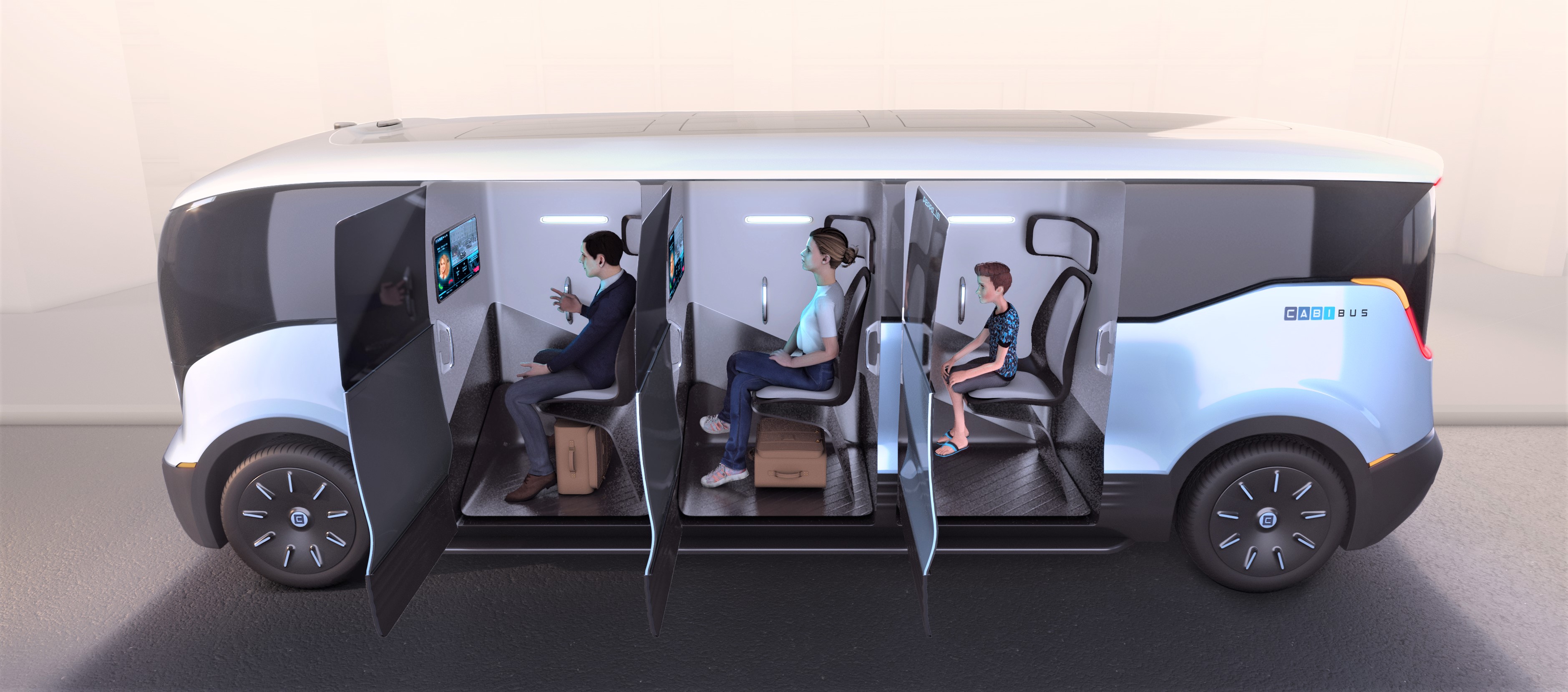
CabiBUS has 3 doors on each side that gives direct access to 6 comfortable 1 person cabins. A rear cabin can be booked for wheelchair passenger, baby stroller or large baggage.
The private cabins in CabiBUS offers privacy and full protection against infections from other passengers. Strong UV-C light destroys all microorganisms in the cabin after one passenger has departed and until CabiBUS stops again to pick up another passenger in that cabin.
Other unique passenger protections, only possible with separate cabins, in case of an accident, is airbags all around each passenger and a strong framework around each cabin.
All types of passengers, from young to old, can feel completely safe and comfortable when sharing rides with strangers in a minibus without driver.
The cabins in CabiBUS are exchangeable so on evenings and weekends, when most people are at home and the demand for personal mobility is lower, the vehicles can be used for parcel deliveries and convenient recycle collection.
The CabiBUS solution is patent protected since 2018 and until 2034.
CabiBUS is a Battery Electric Vehicle, BEV, with no local emissions. It will be designed with sustainability in mind: Low weight, regenerative braking and efficient driveline for low energy consumption. Very long durability, 20-40 years.
Even if the sales of electric cars are increasing in the world, it will take many years until a majority of them are fossil free.
Replacing all current cars with electric cars requires huge amounts of materials for the batteries and cars, so the manufacturing will have a large impact on the environment.
CabiBUS can make the transition to sustainable mobility much faster and with much less materials and investments.
Autonomous cars at SAE level 4 are now developed by several global companies and on 8 October 2020 Google Waymo opened its fully driverless service in Phoenix Arizona.
The EV technology is available on the market since several years.
By offering comfortable, efficient, low cost, convenient, door-to-door, on-demand, safe and secure mobility for everyone, CabiBUS can replace a large part of the cars in the world and greatly reduce the emissions of transportation.
The development of CabiBUS started in 2010 when I saw that the self-driving technology and electric drive could make my old idea for a shared on-demand, door-to-door service both economic and environmental possible. But I also saw the problem with safety and security when sharing rides with strangers in a small vehicle without a driver, so I came up with the private cabin solution.
Before I sent in a contribution to an idea contest for better public transit in 2014, I applied for a patent and it was granted in 2018.
For each year I have been more and more convinced that CabiBUS is the best solution for many mobility problems in cities an regions so last year I invested in a professional design and visualization. This year I set up a company with the first goal to find financing so that I can hire a professional CEO and CTO
| Location | Sweden |
| Website | cabibus.com |
| Founded | 2020 |
| Employees | 1-10 |
| Industries | Maritime & Transport |
| Business model | B2G |
| Funding state | Bootstrapping |
SDGs